Monday, 1 September 2014

Lengha Indian Lehnga Dress Suites Design 2014 Choli Photos Pics Images Wallpapers

Lengha Biography

source(Google.com.pk)
                                       
Clothing in India varies from region to region depending on the ethnicity, geography, climate and cultural traditions of the people of that region. Historically, men and women clothing has evolved from simple Langotas, and loincloths to cover the body to elaborate costumes not only used in daily wear but also on festive occasions as well as rituals and dance performances. In urban areas, western clothing is common and uniformly worn by people of all strata. India also has a great diversity in terms of weaves, fibers, colours and material of clothing. Colour codes are followed in clothing based on the religion and ritual concerned. For instance, Hindu ladies wear white clothes to indicate mourning, while Parsis and Christians wear white to weddings.

History

India's recorded history of clothing goes back to the 5th millennium BC in the Indus Valley civilization where cotton was spun, woven and dyed. Bone needles and wooden spindles have been unearthed in excavations at the site. The cotton industry in ancient India was well developed, and several of the methods survive until today. Herodotus, an ancient Greek historian described Indian cotton as "a wool exceeding in beauty and goodness that of sheep". Indian cotton clothing was well adapted to the dry, hot summers of the subcontinent. The grand epic Mahabharata, estimated to be written between 3000-4000 BC, has a mention of an uneding saree gifted to Draupadi to protect her dignity. Most of the present knowledge of ancient Indian clothing comes from rock sculptures and paintings in cave monuments such as Ellora. These images show dancers and goddesses wearing what appears to be a dhoti wrap, a predecessor to the modern sari.The upper castes dressed themselves in fine muslin and wore gold ornamentsThe Indus civilisation also knew the process of silk production. Recent analysis of Harappan silk fibres in beads have shown that silk was made by the process of reeling, a process known only to China until the early centuries AD.

"The Indians use linen clothing, as says Nearchus, made from the flax taken from the trees, about which I have already spoken. And this flax is either whiter in colour than any other flax, or the people being black make the flax appear whiter. They have a linen frock reaching down halfway between the knee and the ankle, and a garment which is partly thrown round the shoulders and partly rolled round the head. The Indians who are very well-off wear earrings of ivory; for they do not all wear them. Nearchus says that the Indians dye their beards various colours; some that they may appear white as the whitest, others dark blue; others have them red, others purple, and others green. Those who are of any rank have umbrellas held over them in the summer. They wear shoes of white leather, elaborately worked, and the soles of their shoes are many-coloured and raised high, in order that they may appear taller."

Ghagra Choli (lehenga choli)

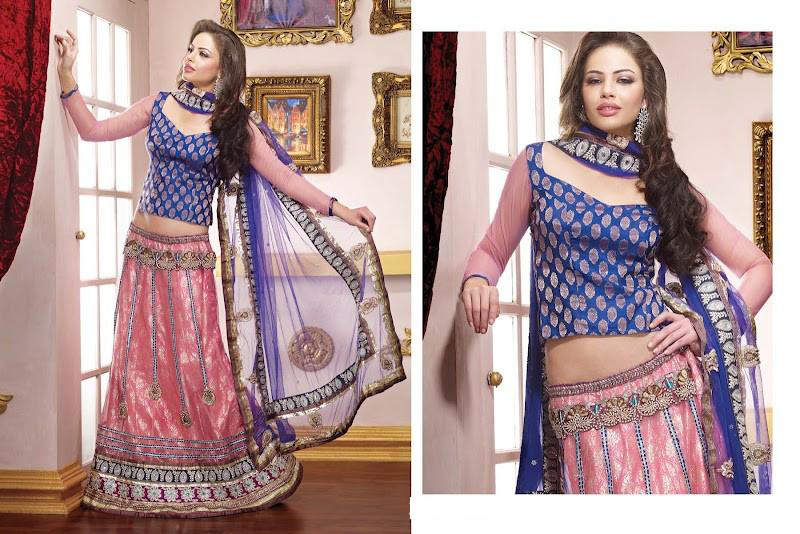
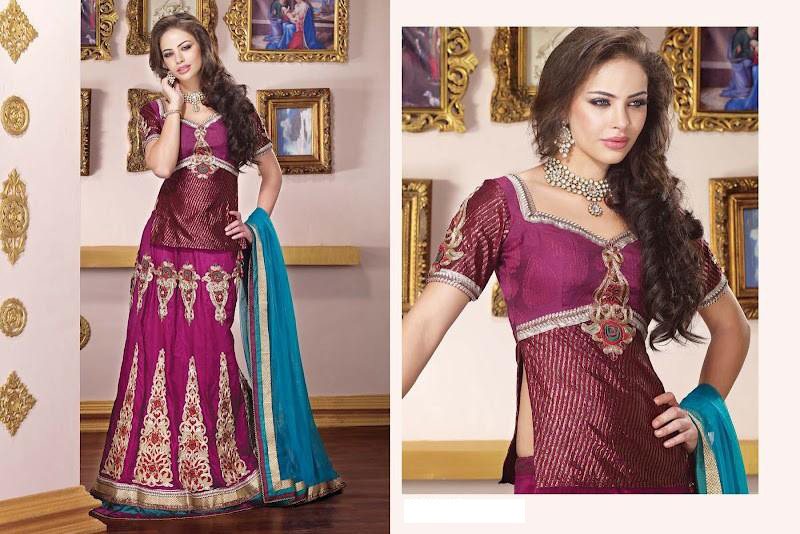
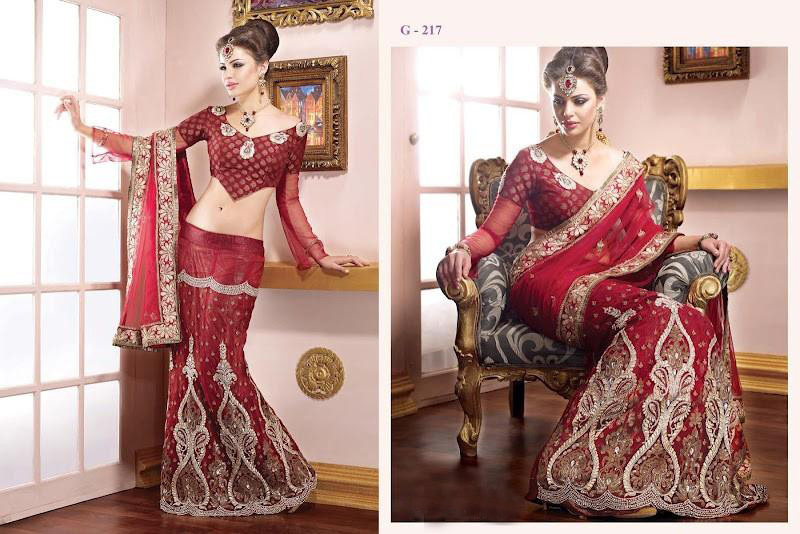
A Ghagra Choli or a Lehenga Choli is the traditional clothing of women in Rajasthan and Gujarat. Punjabis also wear them and they are used in some of their folk dances. It is a combination of lehenga, a tight choli and an odhani. A lehenga is a form of a long skirt which is pleated. It is usually embroidered or has a thick border at the bottom. A choli is a blouse shell garment, which is cut to fit to the body and has short sleeves and a low neck.

Variations

The ghagri was a narrow skirt six feet long the same length as original antariya. This style can still be seen worn by Jain nuns in India.
In Andhra Pradesh it is called as Langa and part of the dress Langa Voni.

Dupatta

The Dupatta is a shawl or large scarf that is worn together with the lehenga and the choli. Until early 21st century Dupatta was the most decorative part of gagra choli, while rest of the garment was more simplistic, especially the gagra. Dupatta is worn in many regional styles across India. Most common style since early medieval times was to pleate the dupatta on the one end and tucking it into the front of the gagra and wrapping it across the waist and over the shoulder or head, similar to the way sari is worn. While women who worked in the farms tucked both ends of dupatta into their choli.


Lengha Indian Lehnga Dress Suites Design 2014 Choli Photos Pics Images Wallpapers 

Lehenga Saree Online Indian Lehnga Dress Suites Design 2014 Choli Photos Pics Images Wallpapers

Lehenga Saree Online Biography

source(Google.com.pk)
                                                     
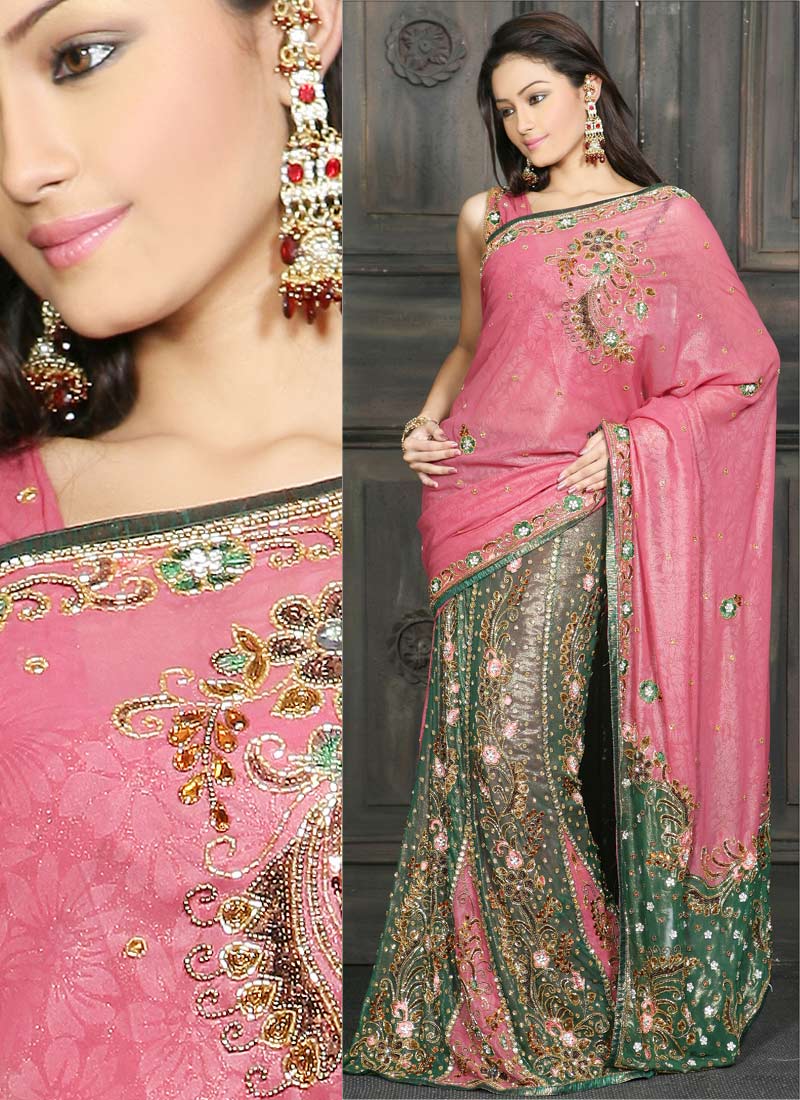
Lehenga style Saree is a new trend of Saree introduced in India. This is an aesthetic blend of the traditional Saree and a Lehenga choli. Lehenga style saree is normally 4.5 meters to 5.5 meters long. Here unlike a sari one doesn't have to form pleats but simply 'tuck and drape'.

As that of a traditional saree, the lehenga style saree is worn over a petticoat (in skirt, pavadai in the south, and shaya in eastern India), along with a designer blouse called as the choli, which is the upper garment. The style of choli mostly resembles that of the choli of a conventional Lehenga or Ghagra choli. Sometimes conventional blouses are also matched with lehenga style saree. The choli is mostly as that of halter neck style, deep neck or “backless” style. As that of the saree, these cholis are also embellished with Kundan, beads, mirrors etc.

Origin

Lehenga style saree is a form of ready-made saree that arose from the need of an artistic yet easy to wear party attire. The easy to wear option of the garment tells the ladies just to slip into it and be ready in minutes. Stitched as a long flared skirt with a zip at the side, it is made to the measurements of the wearer. The ensemble needs to be slipped in, fasten the zipper and drape the pallu over the shoulders. This is an outfit for ladies who are not comfortable with usual drapping and pleating that the regular saree demands. This style of saree’s pallu has the dramatic effect of the matching dupatta of the conventional Lehenga Choli.

Embroidery and embellishments

Various types of Embroidery patterns are employed according to the Lehenga Style saree. Bagh, Chikan, Kashida, Kasuti, Kantha, Sozni, Shisha, Zardozi etc. are some of the commonly practiced Embroidery in Lehenga Style Saree.

Bagh is a special kind of Embroidery done by women in Punjab to be worn during festivals and weddings. Bagh embroidery completely hides the base fabric and is a very heavy kind of embroidery. This Embroidery on Lehenga Style Saree is exquisite as often the cloth is barely visible and only the beautiful embroidery is visible. Kashida is a Kashmiri Embroidery type. This is very colorful and depicts Kashmir in its patterns. The other famous embroidery on Lehenga sarees are Kantha work and Kasuti work of Bangalore.

Various rich and exquisite embellishments are used on Lehenga Style sarees patterns which include Silver embroidery, Golden embroidery, Metal beads, Real pearls, wood beads, glass beads, mirror work, lace work, Kundan, sequins, glittering stones, zardozi etc. Mostly rich fabrics like silk, georgette, brasso, brocade, chiffon, crepe etc. are used in the making of a Lehenga style saree.

In India, Sabyasachi Mukherjee is known for his Lehenga Style Saree

Draping a lehenga style saree

Compared with traditional sarees, the method of draping a lehenga style is relatively simple and hassle-free. The plain end of the saree is tucked into the in petticoat/skirt and wrapped once completely around the waist, similar to wearing a regular saree. Whereas pleats would be formed in a traditional saree, at this point with the lehenga style one continues to tuck in the drape without making any pleats. (In a Lehenga Style Saree, pleats are replaced with embellished gotas or panels at the front, which imparts a flared silhouette that is characteristic of a Lehenga Style Saree.) Finally, the pallu is draped over the shoulder like a regular saree.

The only difference between a Lehenga style saree and a regular saree is that it doesn't require pleats to be formed at the front. Few Lehenga style saris come with side hooks too. Hook it and fix technique fits the Lehenga style saree snugly around the waist.


Lehenga Saree Online Indian Lehnga Dress Suites Design 2014 Choli Photos Pics Images Wallpapers

Lehenga Saree Online Indian Lehnga Dress Suites Design 2014 Choli Photos Pics Images Wallpapers


Indian Wedding Lehngas Indian Lehnga Dress Suites Design 2014 Choli Photos Pics Images Wallpapers

Indian Wedding Lehngas Biography

source(Google.com.pk)
                                                           
Indian wedding clothes is the set of clothes worn by the bride, bridegroom and other relatives attending the wedding during a marriage.

Clothing culture

In India, the wedding rituals and clothes make the wedding as much as that of the bride and her groom. Both look their splendid best in gorgeous clothes. Not just the couple, but the guests attending the family and the relatives are often seen dressed up to the teeth. The bride is dressed up in auspicious colors, whereas the bridegroom is dressed to exude a regale aura. The bridesmaids and best men are often dressed in par with the bride and the groom. But they are toned down a bit because the day belongs to the couple. All the folks attending the marriage are decked up with gold jewelry including the bride and sometimes the groom. The ladies are additionally adorned with henna patterns all over their palms, hands, forearms, legs and feet. Sometimes henna patterns are replaced with alta designs which are short lived and easily removable.

Indian weddings generally tend to continue for several days and new attire is worn each day. All these dresses and the color symbolize the meaning of marriage and the period that follows it. Indian wedding is one that gives more importance to details like different rituals and the various attires one wears to attend them.

Hindu wedding

Indian Hindu weddings continue for several days. India is a country that defines diversity and this is visible even in the wedding and its different styles. The ceremonies, the rituals, the formalities are all different between each region and culture. Unlike the Christians, Hindus wedding ceremony does not resemble the western marriages and are quite elaborate. In the North,Starting from the Tilak ceremony, each function has significance in the marriage. Tilak, Sangeet, Haldi, Baraat and the Shaadi, all necessitate the Bride and the bridegroom to wear new attire at each occasion.All these above ceremonies are known by different names in the other parts,e.g.:Simant puja in the west,or Mangalasnanam in the south and so on.But have got the same significance all over.

Bridegroom's clothes

Many communities of South,West and Eastern India still adhere to the traditional costumes,i.e. Dhoti,or sometimes Lungi,and Mundu by some communities of the South.Kurta or a shirt may be worn or sometimes just a Angavastram may be used to cover the chest. On the other hand in the Northern parts, bridegroom usually wears a Sherwani, Jodhpuri suit or a western suit. The groom’s face is covered with a veiled with a curtain of flowers which is called Sehra in the North,which is not the custom elsewhere. It is also customary to wear a Taqiyah all through the ceremony in Muslim marriages.

Many prefer to wear a Kurta.Kurta can be worn with Salwar,or Dhoti.

A dazzling series of ensemble for bridegrooms include majestic sherwani, blended Indo-western suit and ethnic Jodhpuri suit. The exquisite shirts, coats and jackets are designed with extra care and touch to bring out the magnanimity out of the bridegroom on the marriage day. Precious embellishments are studded into the collars and the cuffs of the bridegroom’s dress. Available both in simple cottons and splendid, royal raw silk, these Kurta Pyjamas are a preferred mostly by the bridegrooms.

Bride's clothes

The bride wears a saree or a lehenga according to the region. Red is considered to be the most auspicious color in among Hindus. While the saree is preferred as the bridal dress in South India, West, East India, most brides of other parts of India prefer Lehenga, Gagra Choli and Odni as bridal dress.

Christian wedding

Christian marriage in India is mostly an adaption of western wedding ceremonies. Here the bridegroom wears a western suit or tuxedo. The Bride usually opts for a silk saree or a western gown


Indian Wedding Lehngas Indian Lehnga Dress Suites Design 2014 Choli Photos Pics Images Wallpapers

Bridal Lehengas Online Indian Lehnga Dress Suites Design 2014 Choli Photos Pics Images Wallpapers

Bridal Lehengas Online Biography

source(Google.com.pk)
                                                       
A choli (Hindi: चोली, Gujarati: ચોળી, Marathi: चोळी, ravike Tamil: ரவிக்கை, Telugu: రవికె(ravike), although choli is the preferred word Telugu Kannada: ರವಿಕೆ) is a midriff-baring blouse or upper garment in the Indian sari costume worn in India, southern Nepal, Pakistan, Sri Lanka, Bangladesh, and other countries where the sari is worn. It is also part of the ghagra choli costume of India. The choli is cut to fit tightly to the body and has short sleeves and a low neck. The choli is usually cropped, allowing exposure of the midriff and the navel.

Choli

The term "choli" is derived from another ruling clan from south, the Cholas. Rajatarangini (meaning the 'river of kings'), a tenth-century literary work by Kalhana, states that the Choli from the Deccan was introduced under the royal order of Kashmir. The first cholis were front covering, with choli tied at the back with four strings. Choli of this type are still common in state of Rajasthan. Pre-Christian era paintings of Maharashtra and Gujarat are considered the first recorded examples of choli. Poetic references from works like Silapadikkaram indicate that during the Sangam period 3rd century BC - 4th century CE in ancient South India, a single piece of clothing served as both lower garment and upper shawl. In Kerala, paintings by Raja Ravi Varma indicate women being topless. On the contrary,other historians point to much textual and artistic evidence for various forms of breastband and upper-body-shawl.

Changing times

During the 1960s, a woman was still not considered a 'lady' if her neckline was cut too daringly and bared too much, especially if she wore her sari pallu pulled to one side, giving a glimpse of her bosom. A lady of honour ideally covered her back and upper arms with a blouse made of a thicker fabric. Of course, not every woman followed the norm. In the 1970s and 1980s, the blouses went knotty, criss-crossed with a deep cut, and even shone through the sheer saree. Anupama Raj, a boutique owner commented, "There is a very real need to re-invent the choli so that it can be worn with a variety of outfits. Just as we see the choli to be a deconstructed form of the blouse, we need to deconstruct the choli. Only then, will it be acceptable internationally." Bobby Malik, an exporter-turned-designer commented,"The choli is the most sensuous of all garments created for women. It not only flatters the feminine form, but also brings out the romanticism in a woman. But where Indian designers have failed is at giving it an international look and making it still more beautiful."
Today the entire approach towards the choli is adventurous. Their metamorphosis has taken cholis from being demure and sedate to daring, with adventurous tailoring and innovative necklines, such as halter, tubes, backless or stringed. Designer Manish Malhotra said, "Since most young people follow a healthy gym routine and are at ease with their bodies, they want to look different and still be effortlessly comfortable. They like to travel and carry a sense of Indianness around them."Designer Vikram Phadnis said, "It's also to do with the fact that the new age woman is well-traveled, well-read and open to experimentation." Sonora Kabir, another Delhi-based designer commented, "Normally, the choli is supposed to hover around the navel area. But if you crop the lower edges and combine it with a funky design — beads, embroidery etc.,— it would be chic enough to be worn over jeans or a pair of trousers."

Fabrics

Traditionally, the choli has been made from the same fabric as the sari, with many sari producers adding extra length to their products so that women can cut off the excess fabric at the end of the sari and use it to sew a matching choli. Cholis can be made from many fabrics. For everyday wear, cotton-based materials such as terry-cot and silk cotton are widely considered the most comfortable. Chiffon, silk, crepe and satin are best suited for formal occasions. The ideal fabric for cholis in the summer is chiffon and georgette. Sheer and other transparent fabrics are considered to add glamour, provided they come with an opaque lining in the right places. Cholis made out of velvet and suede are considered the deadliest faux pas in the Indian culture.


Bridal Lehengas Online Indian Lehnga Dress Suites Design 2014 Choli Photos Pics Images Wallpapers 
Bridal Lehengas Online Indian Lehnga Dress Suites Design 2014 Choli Photos Pics Images Wallpapers